1.08.2012

Physics Practical Readings for First Year students.

These are the images of the sample readings. Please do not copy them, just understand the method of calculation and the way of the writing the observations in your practical note book.

Taking the readings for the first time can be challenging and confusing so these samples can help you in understanding how these are to be attempted. Hopefully you will now not have to search fro Practical Copies of your seniors, brothers or sisters. Just be sure to take your own readings according to this practical.

Readings of experiment: Measure the volume of a given solid cylinder by vernier calliper.


Readings of experiment: Determine the diameter of a given wire and calculate it's area by using screw gauge.

Readings of the experiment: find the volume of a small sphere by using screw gauge.

Drawing and Reading of experiment: determine the unknown weight of a body by vector addition of forces.

Reading of experiment: determine the unknown weight of a body by vector addition of forces.

reading of experiment: Determine the value of "g" by free fall method using electronic ticker time apparatus.

readings of physics experiment: Verify the following relations for a simple pendulum: i. time period is independent of amplitude, ii. time period is independent of mass, iii. time period id directly proportional to the square root of its length.

readings of physics experiment: Verify the following relations for a simple pendulum: i. time period is independent of amplitude, ii. time period is independent of mass, iii. time period id directly proportional to the square root of its length.

Readings of the experiment: find the acceleration due to gravity by oscillating mass spring system.

readings of the physics experiment: verify the conditions of equilibrium using a suspended meter rod.

readings of the experiment: Study the fall of a body through a viscous medium deducing coefficient of viscosity.

Reading of experiment: Find the frequency of A.C mains by Melde's experiment.

Readings of experiment: determine the wavelength of sound in air and calculate speed of sound.

Readings of experiment: Determine the wavelength of sound in air using end correction method.

readings of physics experiment: find the focal length of a convex lens by displacement method.

readings of experiment: find the focal length of a concave lens using a single type concave mirror.

Readings of experiment: find the focal length of a concave lens by using a convex lens type.

Readings of experiment: find the refractive index of a material of a prism by critical angle method.

Readings of experiment: find the refractive index of a material of a prism by critical angle method.

readings of experiment: determine the refractive index of a liquid using a concave mirror.

Readings of physics experiment: determine the wavelength of laser light by diffraction of grating.

readings of experiment: determine the coefficient of the linear thermal expansion of rod.

readings of experiment: find the mechanical equivalent of heat by the electrical type of method.

12.24.2011

How to draw neat and tidy diagrams?

Whether in your practical copies or your Exams, the drawings and diagrams have to be labelled and neat. If you add some shadings and sketchy marks to them, the merrier.
Here are some tips and tricks to make your work look neater:

  1. Never ever draw the diagrams in the middle of the page, draw them towards the left, so that there is space for labeling's.
  2. The diagram should not be very close to the top or bottom, but rather in the middle. There should however be space for the main heading, which should be below the drawing, not above it.
  3. Give the main heading double underlines, and the labeling's single underlines, in case you have shortage of time or space (sometimes the labeling's are too many). 
  4. Make the line end of the labeling's prominent by darkening the ends of the line.
  5. Always use a full stop after each labeling.
  6. make the first drawing with a light pencil, so that it can be rubbed off, when wrong. Once the first correct sketch has been drawn, only then use a dark pencil.
  7. Use a tissue paper or cotton bud to shade or blend the shade.
  8. Make sure your hands are clean before starting the labeling. Often shading leaves the hands gray because of the lead, so clean them up before starting the labeling.

How to draw a skeleton quickly...

How to draw a skeleton quickly in an Exam?
We all know that the more elaborate our answers in the paper, the more marks we will get. In Biology paper the elaboration can of course be gotten through drawing diagrams and labeling them correctly. But due to the shortage of time, mostly students skip drawing diagrams and loose an important opportunity. So here are some tips at drawing the human skeleton which should give your Biology paper an extra boost, if you happen to have a question from the unit on Skeleton, movement and Locomotion.

  1. Learn to be quick in drawing. this can only be if you do loads of practice. I drew this rough image in less than 2 minutes, including the labeling. I know it is not neat and pretty but it was fast and just a practice sketch. If you can do a rough drawing in 2 minutes, you can make a very tidy one in five (for the Exams).
  2. Consider the skeleton to be a man, with a head, two legs, two arms and an abdomen. Instead of flesh however the skeleton will have bones,
  3. If you know which bones are where and there rough size and shape, you can make a quick skeleton.
  4. As this blog is for the students till their twelfth grades, I will say don't worry about the bony tubercles, facets and tuberosities. Just give each bone a rough sketchy feel, so that it looks professional even though it is not.
  5. And finally be very specific about the labeling's, every bone has its own importance so don't mess with their names. labeling's show the Examiner how much you actually know, so be careful with them. have fun with your Biology paper !!!

12.21.2011

Readings of chemistry Practicals for Grade 9 students.

 These are the images of the sample readings. Please do not copy them, just understand the method of calculation and the way of the writing the observations in your practical note book.
In ninth chemistry practicals, we did  11 experiments. Only these 5, however, had calculations and readings in the.
Taking the readings for the first time can be challenging and confusing so these samples can help you in understanding how these are to be attempted. Hopefully you will now not have to search fro Practical Copies of your seniors, brothers or sisters. Just be sure to take your own readings according to this practical.
Experiment : "Determine the boiling point
 of the given liquid" 

Experiment: "Prepare a saturated solution
 of oxalic acid, (COOH2).2H2O"

Experiment: "Standardize the given solution of
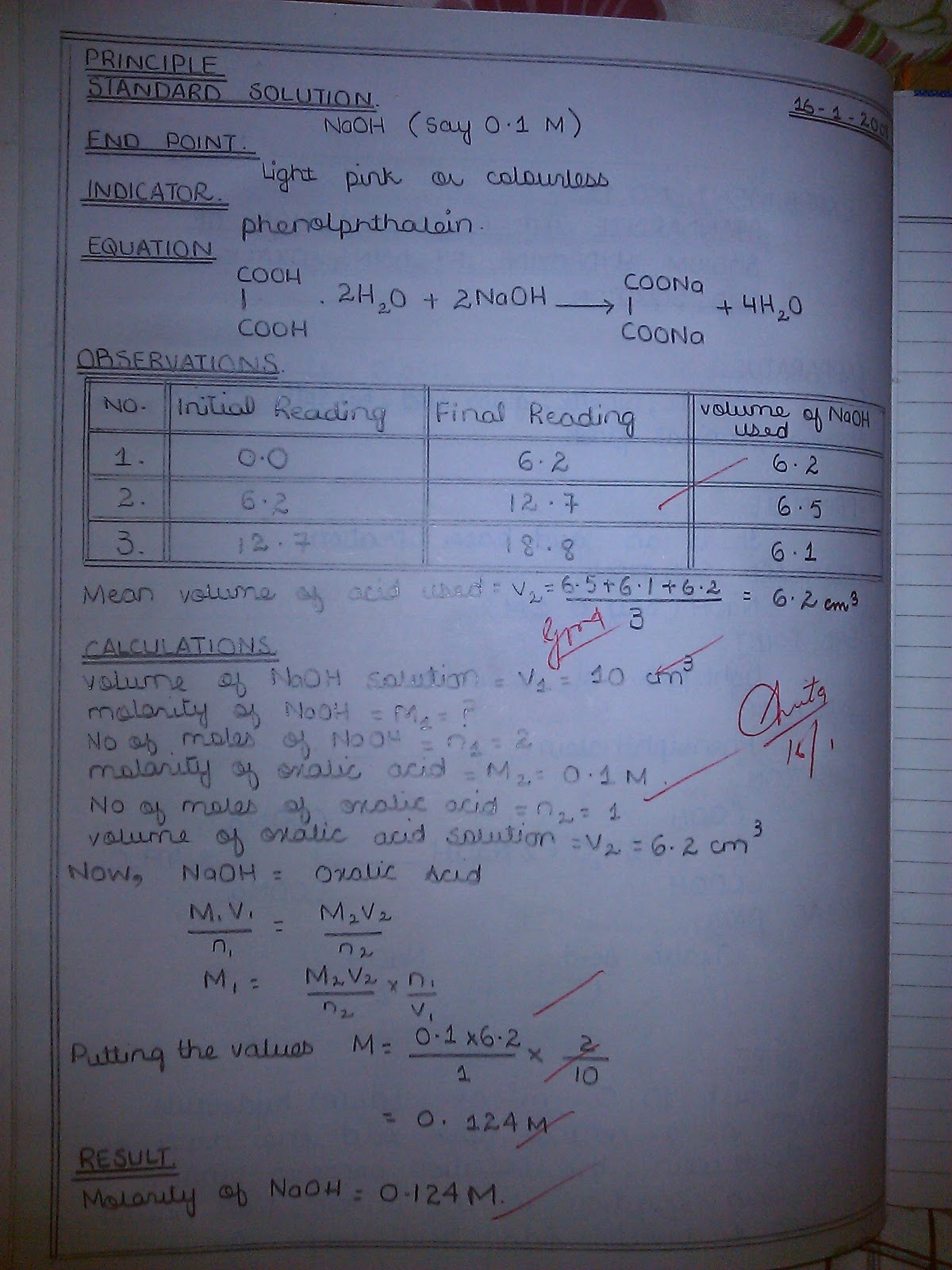
sodium hydroxide by using oxalic acid solution"

Experiment: "Standardize the given solution of
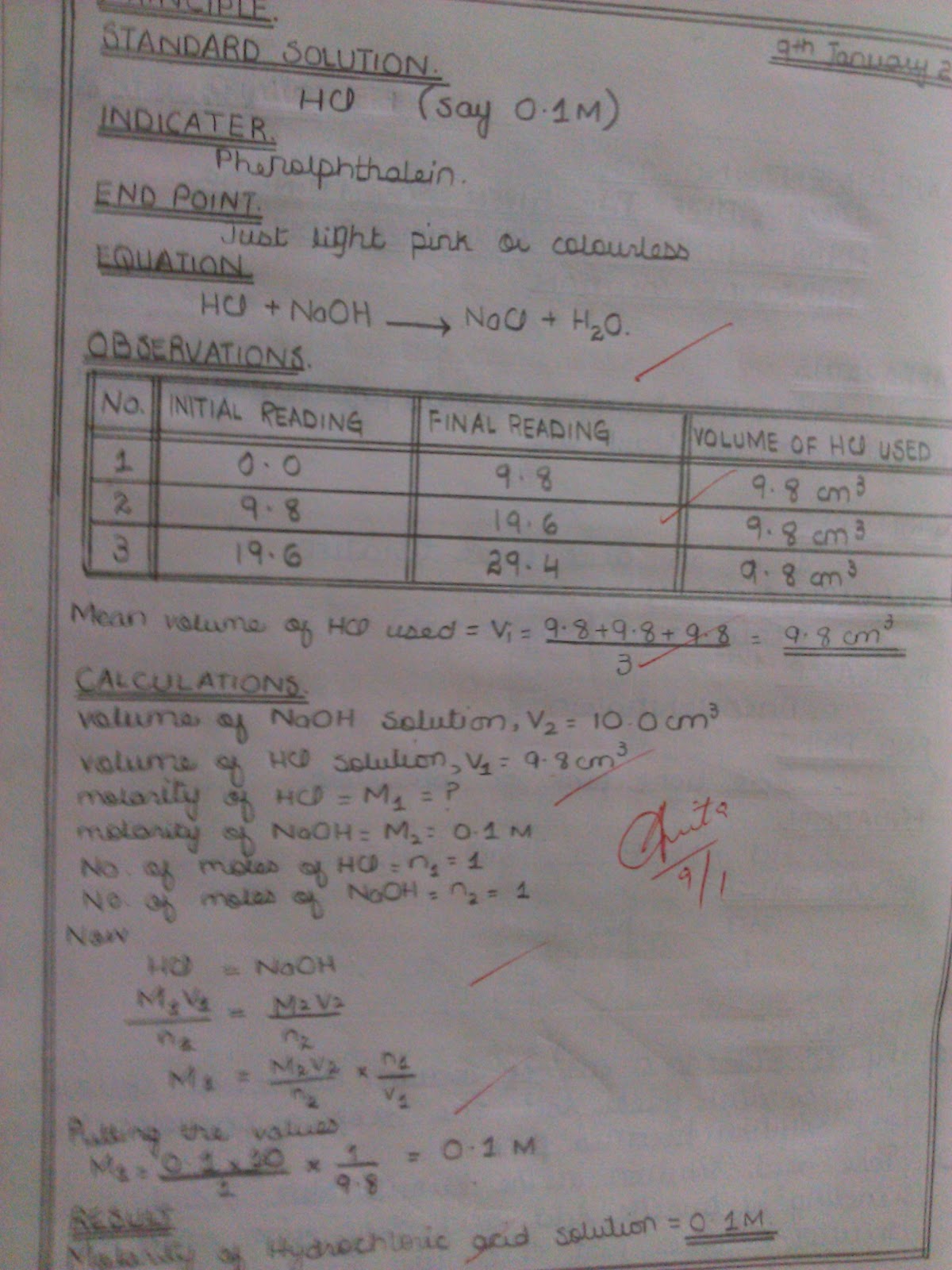
hydrochloric acid by using sodium hydroxide solution"

Experiment : "Determine the melting point of the given compound."

سبق:مکتوب 1,2

سبق:مکتوب 2
From Nazir Ahmad to his son Bashir
Verse 1 for Q.no 1
Verse 2 for Q.no 2


سبق:مکتوب 1,2
From Ghalib to Munshee hargopal Tufta
Verse 1 for Q.no 1 (part 2).
Verse 2 for Q.no 2.
Verse 3 for Q.no 2.
Verse 4 for Q.no 1 (part 1).
The numbers on the left side of the page correspond to the questions numbers according to the Exercise in the textbook. Use the verses accordingly.