Showing posts with label Chemistry Practicals Class 9. Show all posts

2.14.2012

Chemistry practical readings class 9th.

Experiment Readings: "Determine the melting point of the given compound: Naphthalene."

Chemistry Practical Readings: "determine the boiling point of organic liquids: acetone and benzene"

Experiment Readings: "Preperation of 250 cm3 and 500cm3 solutions of oxalic acid."

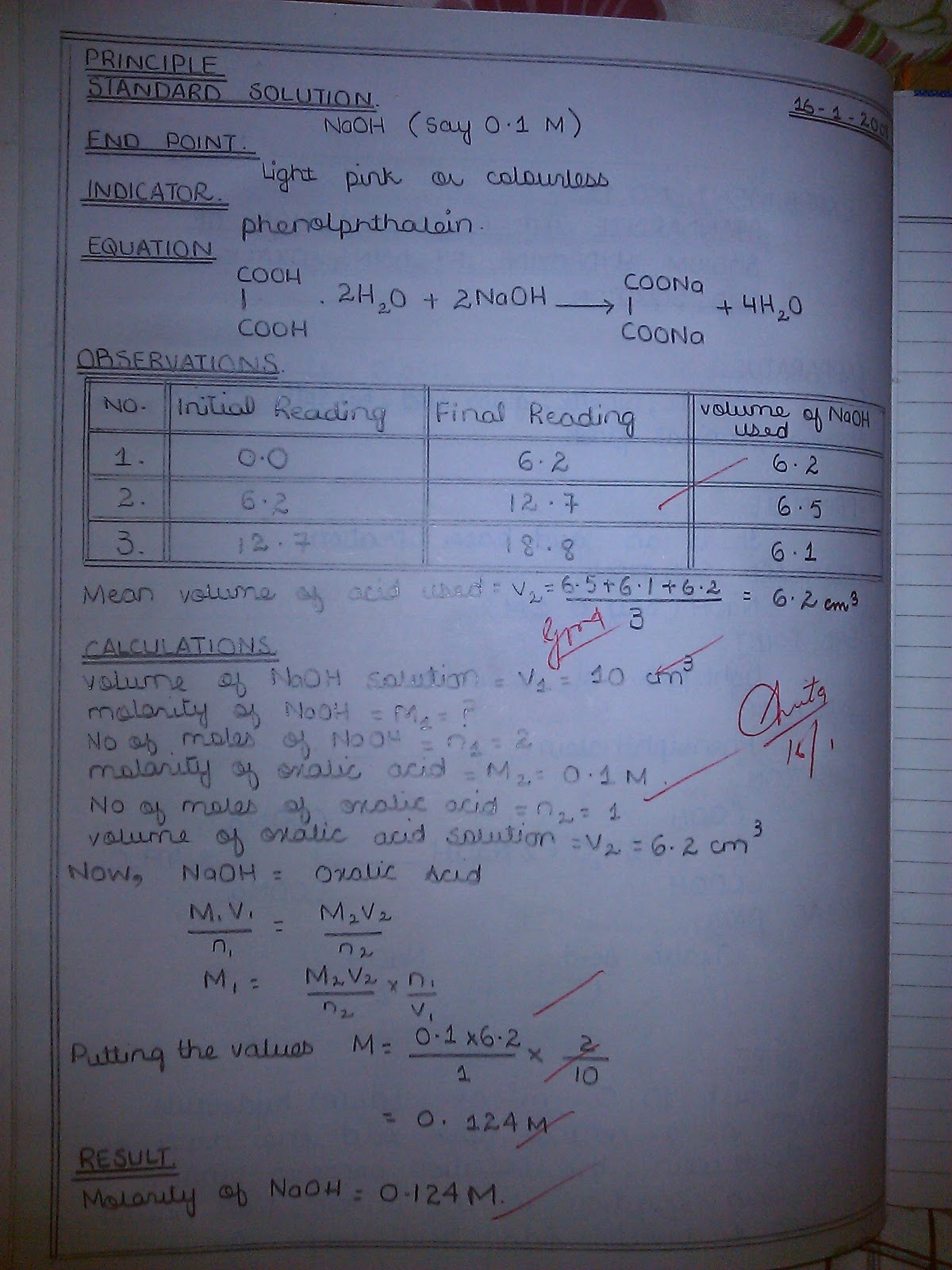
Chemistry Practical Readings: " standardize the given solution of sodium hydroxide by using oxalic acid solution"

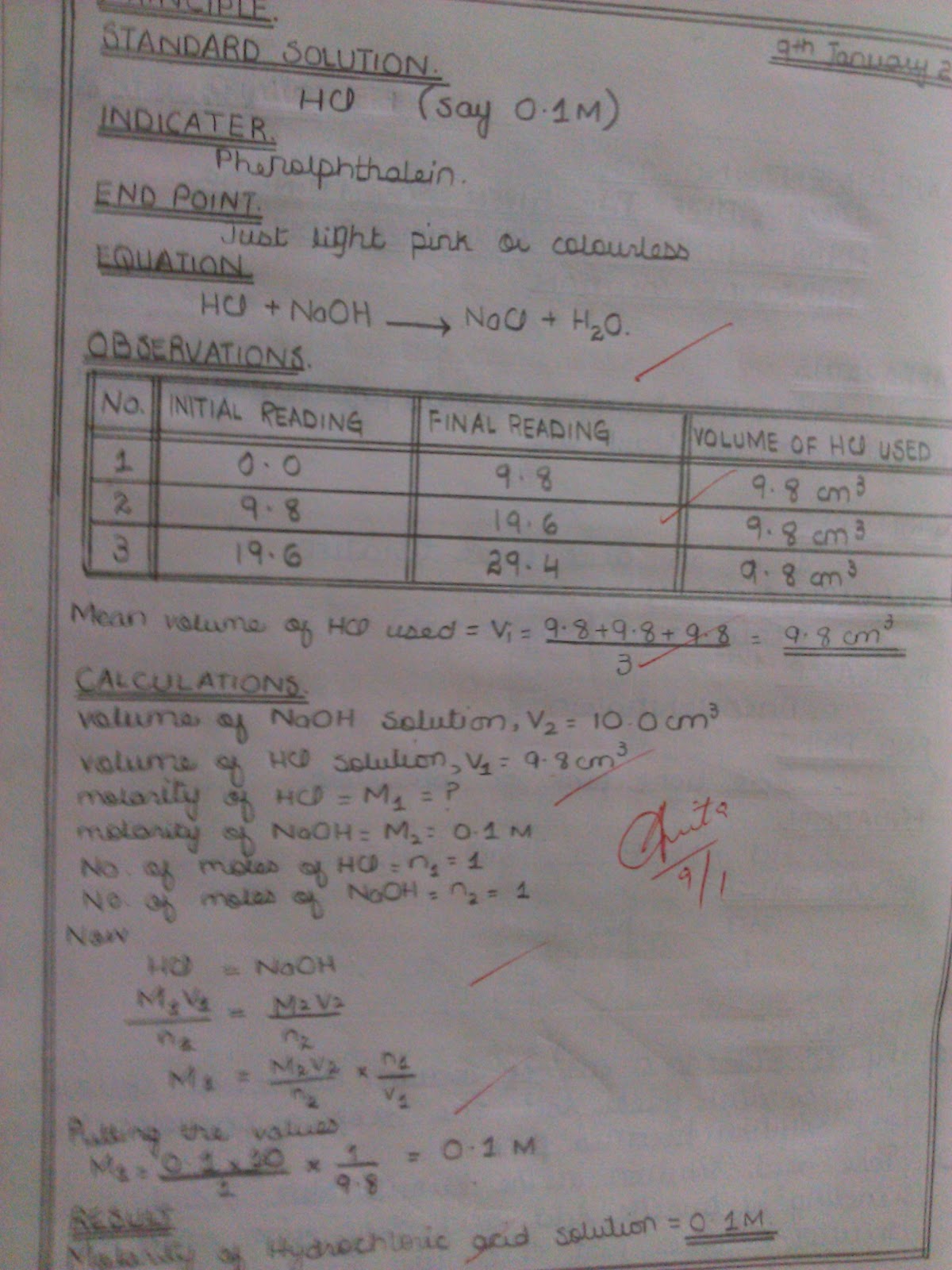
Chemistry Practical Readings: "Standardize the given solution of hydrochloric acid by using sodium hydroxide solution."

1.08.2012

Chemistry practical readings for first year students.

Chemistry practical readings: determination of heat of solution.
Chemistry practical readings and chromatograph: separate a mixture of various inks by paper chromatography.

Chemistry practical readings: determination of heat of solution.

Chemistry practical graph readings: determination of heat of solution.

Chemistry practical readings: Standardization of sodium hydroxide solution by standard solution of oxalic acid.

Chemistry practical readings: Standardization of H2SO4 solution by standard solution of NaOH.

Chemistry practical readings: Determine the amount of acetic acid in the given vinegar.

Chemistry practical readings: Determine the amount of Na2CO3 in a mixture solution.

Chemistry practical readings: Determine the amount of Na2CO3 in a mixture solution.

Chemistry practical readings: Standardization of HCl solution using a standard solution of Na2CO3.

Chemistry practical readings: Standardization of HCl solution using a standard solution of Na2CO3.

Chemistry practical readings: The given solution contains 7.0 grams of washing soda per liter. Calculate percentage purity.

Chemistry practical readings: The given solution contains 7.0 grams of washing soda per liter. Calculate percentage purity.

Chemistry practical readings: determination of NaHCO3 in a  mixture of solution.

Chemistry practical readings: determination of NaHCO3 in a  mixture of solution.

Chemistry practical readings: determination of NaHCO3 in the baking soda.

Chemistry practical readings: determination of NaHCO3 in the baking soda.

Chemistry practical readings: Find the number of molecules of water of crystallization in the given salt of Mohr's salt.

Chemistry practical readings: Find the number of molecules of water of crystallization in the given salt of Mohr's salt.
Chemistry practical readings: Find the number of molecules of water of crystallization in the given sample of  FeSO4.n H2O.


Chemistry practical readings: Find the number of molecules of water of crystallization in the given sample of  FeSO4.n H2O.

Chemistry practical readings: Standardization of potassium permanganate solution by the standard oxalic solution.

Chemistry practical readings: Standardization of potassium permanganate solution by the standard oxalic solution.
Chemistry practical readings: Titration of iodine solution against Na2S2O3 solution using starch solution as indicators.
Chemistry practical readings: Find the strength of oxalic acid solution, using 0.02 molar KMnO4 solution.
Chemistry practical readings: Determine the number of molecules of water of crystallization of oxalic acid by permanganate titration, 6.3 grams of oxalic acid have been dissolved per liter.

12.24.2011

How to draw neat and tidy diagrams?

Whether in your practical copies or your Exams, the drawings and diagrams have to be labelled and neat. If you add some shadings and sketchy marks to them, the merrier.
Here are some tips and tricks to make your work look neater:

  1. Never ever draw the diagrams in the middle of the page, draw them towards the left, so that there is space for labeling's.
  2. The diagram should not be very close to the top or bottom, but rather in the middle. There should however be space for the main heading, which should be below the drawing, not above it.
  3. Give the main heading double underlines, and the labeling's single underlines, in case you have shortage of time or space (sometimes the labeling's are too many). 
  4. Make the line end of the labeling's prominent by darkening the ends of the line.
  5. Always use a full stop after each labeling.
  6. make the first drawing with a light pencil, so that it can be rubbed off, when wrong. Once the first correct sketch has been drawn, only then use a dark pencil.
  7. Use a tissue paper or cotton bud to shade or blend the shade.
  8. Make sure your hands are clean before starting the labeling. Often shading leaves the hands gray because of the lead, so clean them up before starting the labeling.

12.21.2011

Readings of chemistry Practicals for Grade 9 students.

 These are the images of the sample readings. Please do not copy them, just understand the method of calculation and the way of the writing the observations in your practical note book.
In ninth chemistry practicals, we did  11 experiments. Only these 5, however, had calculations and readings in the.
Taking the readings for the first time can be challenging and confusing so these samples can help you in understanding how these are to be attempted. Hopefully you will now not have to search fro Practical Copies of your seniors, brothers or sisters. Just be sure to take your own readings according to this practical.
Experiment : "Determine the boiling point
 of the given liquid" 

Experiment: "Prepare a saturated solution
 of oxalic acid, (COOH2).2H2O"

Experiment: "Standardize the given solution of
sodium hydroxide by using oxalic acid solution"

Experiment: "Standardize the given solution of
hydrochloric acid by using sodium hydroxide solution"

Experiment : "Determine the melting point of the given compound."